When a pastor delivers a sermon on the Beatitudes, and afterward members in the congregation ask, “Where did he get the woke Liberal talking points from?”, something is terribly wrong.
Throughout history, there have been many examples of governments using religion to oppress the people. The Church of England and its oppression in America’s colonial period is a great example and was fresh on the minds of the Founders when they wrote the Constitution.
The separation of church and state is a principle rooted in the First Amendment of the U.S. Constitution, specifically the Establishment Clause and the Free Exercise Clause. While the phrase “separation of church and state” isn’t in the Constitution, it originates from a letter by Thomas Jefferson, who used the metaphor to describe the intent of these clauses, which state that “Congress shall make no law respecting an establishment of religion, or prohibiting the free exercise thereof”.
Throughout history, power and belief have been intertwined, and few relationships have been as fraught with manipulation as that between governments and religion. Though faith can serve as a profound source of meaning and moral guidance, it has frequently been co-opted by state authorities as a potent tool for oppressing people. By exploiting religious narratives, governments can manufacture consent, stifle dissent, and justify heinous abuses under the guise of divine will. This manipulative symbiosis has been a recurring theme across cultures and eras, revealing a pattern in which political leaders have weaponized faith to consolidate and maintain their power.
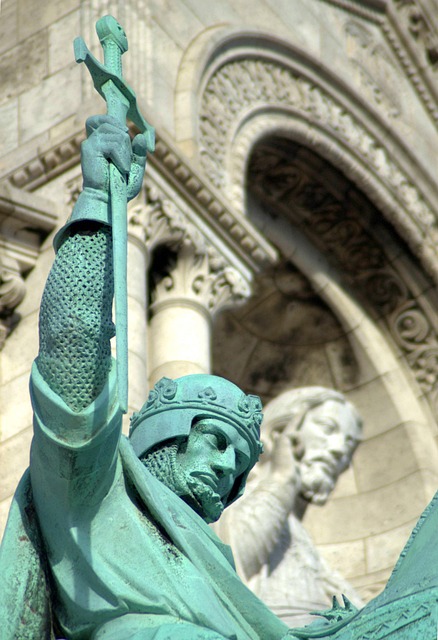
One of the most direct methods governments use to oppress populations through religion is the justification of violence and conquest. The Crusades, spanning the 11th to 13th centuries, provide a stark historical example. Political and economic motives drove these campaigns, but they were framed as a divine mandate to reclaim the Holy Land, which masked the geopolitical and expansionist goals of European monarchies. By infusing their wars with religious zeal, rulers transformed their soldiers into righteous crusaders, motivating them to commit brutal acts against non-believers.
In the modern era, extremist groups like ISIS have similarly used radical interpretations of religious texts to justify terrorism, impose draconian laws, and carry out widespread human rights abuses with the claim of divine sanction. This practice effectively paints victims as enemies of God, stripping them of their humanity and making their oppression seem morally permissible.
Beyond outright violence, governments employ religion to entrench and reinforce social hierarchies, thus justifying systemic inequality. The caste system in India, for instance, used Hindu doctrine to establish a rigid social stratification, relegating lower castes, especially Dalits, to severe social and economic marginalization. By portraying this system as divinely ordained, rulers and religious elites entrenched inequality and justified the exclusion and mistreatment of millions for centuries.
Similarly, during the transatlantic slave trade, some Christian interpretations were used to justify the brutal subjugation of Africans. By manipulating religious texts to suggest that certain people were destined for servitude, leaders masked the inhumane and exploitative reality of their actions with a veneer of religious legitimacy. This ideological justification enabled the dehumanization of enslaved people, making it easier to perpetrate their oppression.
Governments also use religion to suppress dissent and control their populations by stifling independent thought and enforcing conformity. Historically, institutions like the Inquisition were used by the Catholic Church to enforce religious orthodoxy and root out any deviation, often with state backing. Through the use of torture and persecution, it served to eliminate political and religious opponents, consolidating power in the hands of both spiritual and secular authorities. In contemporary authoritarian regimes, the suppression of independent religious expression is a key tactic for controlling society. As observed in Russia, governments may favor one faith to gain support while ruthlessly punishing competitors, such as Jehovah’s Witnesses.
China offers another example, where the state seeks to control religious movements to prevent the emergence of a strong civil society that could challenge its authority. This suppression of religious pluralism is a defining feature of regimes that fear losing control.
Finally, governments manipulate religion by selectively co-opting religious leaders and funding favored institutions. This strategic favoritism can be used to control the dominant faith, ensuring it promotes obedience and allegiance to the state. In some instances, authoritarian regimes partner with religious establishments to advance their rule. This creates a system where favored religious leaders support the government in exchange for financial support or other benefits, effectively turning the religious institution into an extension of the state. This can be seen in places like Russia and Saudi Arabia, where governments subsidize favored faiths while simultaneously harassing or persecuting minority religious groups. By promoting a state-sanctioned version of faith, these governments use the sacred for profane political ends, using religious institutions as a mechanism of social and political control.
Antonio Gramsci wrote from his prison cell much about the Catholic Church. Gramsci’s theory of cultural hegemony emphasized the role of institutions in civil society—such as schools, churches, and the media—in shaping a population’s beliefs and values. Rather than a “war of maneuver” to seize the state directly, he advocated for a long-term “war of position” to subvert these cultural institutions from within and build a counter-hegemony.
Transforming faith: Rather than forcing Catholics to become communists, Gramsci theorized letting them remain Catholic but transforming their faith into a secular, Marxist-aligned form. He understood that for many, faith is rooted in deep-seated passions and common sense rather than pure reason, and a successful counter-hegemony must also appeal to people’s feelings and traditions.
This is why the church needs to be separate from the government. It is a firewall that keeps a country from falling into an oppressive regime as people serve a higher authority than the state. Eisenhower put “Under God” in the Pledge of Allegiance as a reminder that we serve God first. When a religion becomes an arm of a Nationalist movement, there is always a time when the congregation is forced to choose supporting a politician over God. We are seeing it now. We have seen it before. Many times in history.
Houston, we have a problem.




Nice piece